|
|
|
|
|
|
|
 |

|
 |
The impact and success of a studio portrait is often the combined result of lighting, composition, body language, lens choice, camera angle, clothing, color, texture, and even luck.
With a few portrait techniques under your belt, however, your luck will improve dramatically. There are many portrait-making methods that can help you develop your own style over time and ultimately make your work unique.
|
This lesson illustrates some basic tips that will bring immediate positive results to your portrait photography.
(Most images can be clicked for an enlarged view.) |
Topics Covered:
- Studio Set-Up
- The Head & Shoulder Portrait
- Facial analysis
- Facial Analysis With Your Main Light
- Double Chins
- Narrow (Short) Lighting
- The 3/4-View
- Broad Lighting
- Split Lighting
- The Profile
- Camera Height Relative to the Subject
- Lens Choice for Portraits
- Posing the Female
- Close-up Feminine Pose
- Masculine Pose for Female
- Posing the Male
- Close-up of a Male
- Another Slimming Technique
- The Eyes Have It
- Eyeglasses: Distortion and Glare
- Expression
Equipment Used:
|
Many of the techniques illustrated in this series are subtle and may only require slight adjustments to the subject to create a more pleasing and natural representation. But first, let’s look at how a photographer might go about trying to render their subject’s individual style or personality.
Communication with your subject is paramount. And the way in which you communicate with a subject as you go about trying to capture a particular expression (arguably, the most important element in a portrait) is something that is unique to your personality and cannot be replicated by following a lesson plan. The best way to find a style that works for you is to observe as many working professionals as you can and practice their techniques until you find one or more that feel comfortable.
In most cases, a portrait client is simply looking for a photographer who can render a better-looking photo than they themselves could take with a compact camera permanently set to AUTO. Many of your clients will claim they don't photograph well. But you should see that as a good thing. Because after you prove them wrong and create beautiful, custom portraits for them, you will have won them over.
If you make beautiful portraits of a fashion model, however, she or he may not be as impressed. After all, photos of models tend to look good even if they’re shot with the compact camera permanently set to AUTO. But to make someone look good that typically doesn’t photograph so well requires a little more effort on behalf of the photographer.
|
|
 Figure 1 |
Studio Set Up
There are many styles and techniques for lighting a portrait. For this lesson we used a 3’ OctoDome as a main (key) light for the head & shoulder portraits.[figure 1]
A 5’ OctoDome was used as the main light for the full-length shots. Our fill light was a 3’ OctoDome, placed very close to the camera on the opposite side as the main light. Many portrait studios will use a larger fill light, centering it above the camera so that it doesn’t need to be moved when adjusting the main light.
|
|
The contrast was controlled by raising or lowering the output of the fill light. A 3’ HalfDome on a boom was used for the hair light. A silver LiteDisc reflector was used primarily as a rim light (a soft gold or gold reflector is often used in this position for a warming effect.) It was positioned behind the subject on the opposite side as the main light. It used light from the main light and bounced it back as a rim light for the shadow side of the head and body.
|
|
The Head & Shoulder Portrait
For the close-up photos in this lesson, our subjects were seated. The ideal situation is to have an adjustable posing stool and adjustable posing table, so that the subject can lean on the posing table comfortably, while being able to position their arm in a natural way.
Throughout this lesson, we purposely used more primitive stools of different heights, along with books to raise the subject height when necessary. |
 Figure 2 |
|
When your subject sits on a stool, have them sit as tall as possible and then relax their shoulders. When you ask your subjects to lean forward, make sure they lean from the hips and not from the back, which can cause them to slouch. [figure 2] |
|
|
Facial analysis
With practice, you can train your eye to look for what does or does not flatter your subject. By doing a facial analysis prior to jumping into the photo session, you allow your subject the chance to get used to the environment and develop trust in your technique. I tell my clients I am looking for their best side, but I am equally concentrating on what constitutes their less-than-best side. When determining features that can be minimized or accentuated, it’s best to do so under flat lighting conditions.
|
|
|
Facial Analysis with Your Main Light
Once you’re on the set, take your main/key light and move it from the left side of your subject to the right to see which is more flattering. Continue with this analysis as you adjust the height of the light. Then have your subject slowly turn their face toward the main light to observe the effects of the facial shadows.
Observe the effect of the light on the nose - sometimes one side will create a straight shadow line on the nose, while the other will create a crooked shadow line, giving the appearance of a crooked nose.
Look for scars, pimples, or similar facial imperfections that are accentuated or minimized by your lighting treatment. A scar or pimple on the opposite side of the face from the main light may cast a shadow, thus exaggerating the imperfection. If the scar or pimple is on the same side as the main light, the light will most likely not cast a shadow, making it less noticeable.
Watch for the cheek shadow on the opposite side of the main light, as raising the light can often define and slim the face. A higher main light angle will often improve the facial appearance -particularly for men - but watch out for those with dark circles under their eyes, as this feature may become exaggerated. In such cases, using a reflector underneath to bounce light into the shadows will help minimize the circles. With high main light angles, however, watch out for the eyes. Deep-set eyes often require a lower light angle for adequate illumination.
|
|
Double Chins
This technique works best with a telephoto (portrait) lens. For this example, I asked my daughter to exaggerate a double chin for comparative purposes. [figure 3]
|
 Figure 3 |
|
Next, I asked her to effectively hinge her head from the base of the neck, rather than at the top of the neck, pulling the chin forward, toward the lens. [figure 4]
In the second result, notice how the chin is angled a little down, along with being stretched forward toward the lens. This, combined with narrow lighting (which will be discussed in a subsequent lesson) is one of the best weight reduction techniques in portraiture.
|
|
 Figure 4 |
Note that this technique won’t work as well with a normal lens shooting full length.
To see this effect in person, try looking in a mirror and close one eye. When you view the “projected chin” effect with one eye, the neck does not look distorted like it does with the 3-dimensional view afforded by two eyes. The effect is further enhanced with a telephoto (portrait) lens, which helps compress the subject matter.
|
Narrow (Short) Lighting Many people will benefit from narrow lighting and positioning, especially if they have a wide or round face.
Here is a classic example of broad lighting, with the face turned away from the key light. Notice how the main light almost exaggerates the broadness of the face. As you might expect, broad lighting is typically more successful with people who have narrow faces. [figure 5]
|
 Figure 5 |
 Figure 6 |
By contrast, this result shows the model with her face turned toward the key light, causing the right side of the face to be on the shadow side. Although this example is subtle, this change of positioning has the effect of narrowing the face. [figure 6]
Note that if you wanted to narrow the face even further, you would simply move the main light further to the left.
|
The 3/4-View
Here, the subject’s head is positioned halfway between a profile and 3/4-view. Notice how the nose breaks the cheek line, giving a somewhat distorted view of the face. This is a great example of why you need to think in two-dimensional terms when posing your subject. Shapes can be controlled by your positioning and lighting, and if there interruptions in these shapes, it can disrupt the flow of the overall shot. [figure 7] |
 Figure 7 |
 Figure 8 |
This shot, on the other hand, shows a much more graceful and engaging result. The subject’s head here is now more at a 3/4-view. Note that the light position is the same as it was in figure 7, but the effect due to the change in position is significant. [figure 8]
In addition to narrow lighting such as this, having your subject jut their chin slightly forward can be a simple way to flatter your subject. There’s that old photographic saying, “The camera adds 10 pounds.” Well, these techniques can help to counteract that unflattering phenomenon.
|
 Figure 9 |
Broad Lighting
Broad lighting is usually best suited for someone with a narrow face. For women who have applied makeup to define the face, broad lighting can be used very effectively. This lighting is quite common in fashion photography, where models tend to be on the exceedingly thin side.
Note that for men, a beard will often have a narrowing effect of the face even, with broad lighting. Depending on the tone of the beard and its length, it can create the same shadow effect of narrowing the face. [figure 9]
|
Split Lighting
Split lighting, where the key light is only on one side of the face, can be used to create a more dramatic look. Similar to short lighting, it can also have the effect of narrowing the face. Additionally, it can be used to hide flaws on the shadow side of the face or give the nose a more flattering appearance. [figure 10] |
 Figure 10 |
|
The only way to know if it works for your subject is to put them in a split lighting set-up and see how it looks. You can then adjust your fill intensity to create the contrast you think looks best. In certain situations, you may even want to use the black side of a reflector on the shadow side of the face, to eliminate detail in the shadow area for a dramatic effect. This is called “negative fill.”
Finally, a rim light positioned somewhat behind the subject on the opposite side of the main light can make for a more dramatic look as well. In figure 10, we used a silver reflector for the rim light. If you want it stronger, use a soft box (use a grid on the rim light soft box to keep light off the background.)
|
|
 Figure 11 |
The Profile
The lighting you use for a profile portrait can be very engaging if done properly. Often times, a narrow lighting or rim lighting approach can work to accentuate the profile in an elegant, yet striking way.
This first example is a less-than-optimal profile, as it shows part of the opposite cheek and breaks the line of the profile. Also notice how the hair dangling below the chin on the far side of the face is distracting and detracts from the line of the profile.
|
|
For the fill light, it’s typically best to have it be less intense in order to draw the viewer’s eye to the line of the profile. For a close-up profile like this one, the fill light could simply be a reflector positioned close to the main light (on the same side) that both bounces light into the shadow areas of the face, as well as blocks the main light from shining directly into the lens.
|
|
In this shot, because of the angle, the profile is not interrupted by the opposite cheek or hair. How much of the opposite eyelash to show depends on the individual. The main objective here is to not have the cheek break the line of the nose. [figure 12]
When shooting a profile shot, have your model look ever so slightly toward the camera, as this will end up looking more natural. When the eye looks straight ahead in a profile, it usually shows too much of the white area and not enough of the iris.
|
 Figure 12 |
 Figure 13 |
Notice how our subject’s body is turned facing away from the camera. This angle is an excellent choice for brides where you can also capture the detail in the back of the wedding dress. [figure 13]
Note, however, that this pose can be somewhat unflattering around the neck, especially for those who are overweight. You can combat that problem, though, by positioning the hair or a bridal veil over the wrinkled neck area.
|
|
Camera Height Relative to the Subject
With respect to perspective in close-up portraits, it’s usually best to keep the film plane parallel to the facial plane, usually at eye level. That said, modifying this rule slightly can help to correct flaws or even make a creative statement.
For 3⁄4 or full-length shots, the best height for the camera is usually between chin and chest level. This helps to prevent your subject from appearing distorted. For a full-length shots, the camera is usually best positioned between chest and waist level.
|
|
|
Lens Choice for Portraits
For a full-length shot, use either a normal lens or moderate telephoto lens. The lens approximates the diagonal distance across the film plane. So for full frame 35mm, a normal lens is around 50mm. For the average digital sensor, however, it is typically half that - about 25mm. A moderate telephoto lens is about 70mm-85mm for full frame 35mm, and 35mm-42mm for digital sensors.
For a 3/4 length shots, use a moderate telephoto or telephoto lens. For head and shoulder close-up shots, use a telephoto lens, which is about 105mm-135mm for full frame 35mm, and 52mm-67mm for digital sensors.
|
|
 Figure 14 |
Posing the Female
For full-length shots, the body pose is critical in how it conveys emotion or character to the viewer. Here we positioned our subject standing, facing straight on to the camera with equal weight on her feet. This makes for a static, almost confrontational effect. [figure 14]
Notice the difference when our subject has shifts her weight to the back foot. Her body now faces away from the camera and her front foot points toward the camera. [figure 15]
|
 Figure 15 |
Rather than dangling at the sides of the body, the arms have now created a space that gives the body a more slender appearance. When the arms are positioned alongside the body, they add to its mass. This effect is more noticeable in a two-dimensional photograph than it is in three-dimensional reality. |
|
Notice how the head is slightly tilted to the high shoulder, giving a slight curve to the body. [figure 15] This is a classic feminine pose, and men are usually not photographed in this manner. If the head were perpendicular to the shoulder, it would be a more masculine pose and would be suitable for both men and women. A woman who is heavier will often photograph better in the masculine pose, as a feminine tilt of the neck can result in an unflattering look.
|
|
Close-up Feminine Pose
Here is the classic feminine head-and-shoulders portrait. Our subject is seated on a small stool and her body is turned away from the key light. She is leaning slightly back from the camera with her right shoulder higher than the left. [figure 16] |
 Figure 16 |
|
When posing your female subject, remind her to sit as tall as she can, to relax her shoulders, and to lean from the waist and from the back.
Just before taking this shot, I asked this model to pull her chin a bit forward toward the camera, turn her head a little toward the key light, and tilt the top of her head slightly toward her high shoulder.
|
|
 Figure 17 |
Masculine Pose for Female
For a more authoritative look, you can position your female subject in a somewhat different manner. Our subject’s body now faces the main light. Notice how she is leaning slightly forward with her low shoulder closest to the camera, and that her head is more perpendicular to her shoulders. Also note that the camera is now tilted slightly to improve the composition. [figure 17] |
Posing the Male
Men tend not to be as receptive to posing direction as women, but if you can convince them that it will greatly improve the shot, you’ll get much better results.
First, we positioned our subject so he was square on to the camera with equal weight on both feet. Kind of stiff and boring, don’t you think? |
 Figure 18 |
 Figure 19 |
After a little posing direction, we now see our subject in a more relaxed, natural-looking position. Notice how the weight is shifted to the back leg, with the body turned a little to the main light. The head is perpendicular to the shoulders, which reflects a classic masculine pose.
For a more corporate look, this shot could be further improved with a suit coat, allowing the shirtsleeve to peek out of each coat arm.
|
Close-up of a Male
Remember the classic female pose demonstrated in figure 16? Well, here’s the same pose with a male subject. With the high shoulder forward and the head titled toward it, the overall look is not as flattering as it could be [figure 20] |
 Figure 20 |
 Figure 21 |
This second result shows how much better the classic masculine pose works for this male subject. Notice how he is leaning toward the camera and a little away from the main light? With the lens tilted slightly, it makes for a nice composition. [figure 21] |
Another Slimming Technique
When the body is square on to the camera, it can be rendered heavier than how you see the person in real life. [figure 22]
By turning the shoulders and cropping into the near shoulder, you can use the camera perspective to flatter your subject. [figure 23] |
 Figure 22 |
 Figure 23 |
Turning the shoulders away from the camera shows less of the far shoulder and allows you to crop the side closest to the camera to match the proportion of the far shoulder (figure 23). |
|
The Eyes Have It
Here are some key eye issues to look out for:
*One eye is lower than the other - If you have your subject tilt their head down on the same side as the lower eye, the unevenness will be exaggerated. Have them tilt it the other way to make it less noticeable.
*One eye is narrower than the other - If the head is turned so that the narrower eye is closest to the camera lens, the wider eye will appear relatively narrower, as it is further from the lens. Another method is to allow a bit of shadow to cover the larger eye.
*Deep-set eyes – As mentioned previously, lower lighting angles help to keep the eye sockets out of shadow.
*Crossed or one eye wandering - This may take experimentation depending on the individual. Try turning the weak eye away from the lens. In some cases, asking the subject to close their eyes and then take the shot just as they open them. (Also, try this technique with fashion portraits to achieve an intimate expression with the subject looking directly into the lens.)
*For profile - A general rule of thumb is to let the eyes follow the nose. However in many profiles, this may cause too much of the white of the eye to be visible, and not enough of the iris. In such cases, it actually looks more natural to have the subject look slightly toward the camera. But remember - just slightly.
TIP: Create a circle with your thumb and index finger and position this circle where you want your subject to look. Then ask them to look through the hole and keep looking that direction when you remove your hand.
Eyeglasses: Distortion and Glare
Unwanted reflections in eyeglasses can be very stressful for those starting out with studio lights. It used to be fairly common for a studio photographer to either physically remove the lenses from frames or substitute glassless frames for a portrait. And it wasn’t always just for the sake of reflection. Distortion of the cheek line behind the glass would be fairly evident for those with thick lenses. So without glass in the frames, there are no reflections and no distortion.
But the times and photographic approaches have changed. Rather than think in terms of eliminating distortion in the glass, consider how abnormal the subject would look without the distortion people are accustomed to seeing with that person? Personally, I prefer to keep the distortion for authenticity’s sake.
|
|
The easiest way to avoid glare in glasses is to have the subject turn slightly away from the primary light source. Remember, the angle of incidence equals the angle of reflection, and you don’t want your subject’s eyeglasses to inadvertently bounce studio lights into the camera lens. [figure 24]
Keep in mind, however, that major repositioning may disrupt other elements you want to maintain. |
 Figure 24 |
 Figure 25 |
A gobo was introduced between the main light and the subject to cast a subtle shadow across the ear, shoulder and lower part of the jaw in this shot. [figure 25] This not only cut down the hot light on the shoulder and ear, but helped give a bit of a slimming effect to the face (figure 25). |
|
A gobo (short for “go between”), also called a flag, is just an object placed between the subject and light source to modify the light. In this case, it was placed at the end of a stand-mounted LiteDisc Holder and adjusted to cut down the light in the area where it was too strong. [figure 26] |
|
 Figure 26 | |
For the next shot, I had the subject turn into the main light for narrow lighting. The glasses were tilted downward, thus raising the arms up slightly on the sides of the face. Note that this usually only works for a fairly straight-on shot where the person has some hair to cover the frames at the ears. [figure 27] |
 Figure 27 |
|
Additionally, the main and fill lights were raised slightly to help prevent the reflections from showing up in his glasses. Just keep in mind that the higher you position the main light, the more you risk adversely affecting the light modeling on the face.
|
|
|
Expression
Arguable, one of the most important elements of a portrait is the expression. If you think of "posing" as guiding, then it might be easier to develop a style that will get the expression you are looking for. The idea is to guide your subject into a flattering position that photographs well, while allowing the subject to look natural and for the photo to not appear contrived.
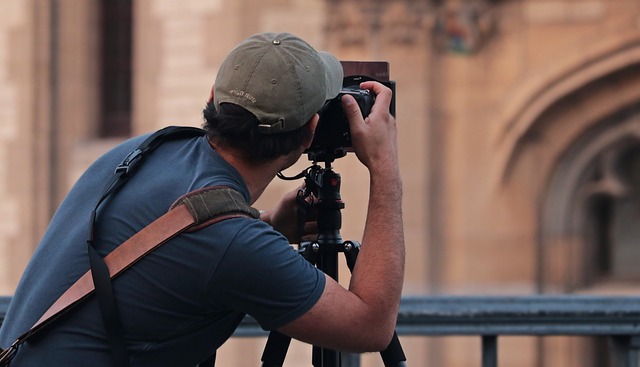
For many portraits, especially groups, a good technique is to put your camera on a tripod. Not only to decrease camera shake, but more importantly, to free you up to jump in to make quick adjustments and not have to spend time when returning to the camera to re-compose the shot. If you pose your subject, then go back to the camera and adjust your composition, you will lose the spontaneity of the moment and risk a very stiff, posed looking shot.
Your camera settings should be made before you start posing your subject. One technique is to first get your client into the pose you want. Then return to the camera and give your subject any last-minute directions to fine tune the pose, and then get the expression immediately after the last direction (such as, "Just tilt the top of your head a little to the right...").
Another way to improve communication with your client is to practice giving easy-to-understand directions (before the shoot) so that you don't lose the moment with the client giving you a confused expression.
I will often hold my hands in front of me, as if I am cradling their head, to illustrate how I want them to position their head (figure 28). |
|
 Figure 28 | |
|
To help your subject to relax, it often works to ask them to take a deep breath and then exhale - then go for the expression. Sometimes I'll ask the subject to close their eyes and concentrate on relaxing the muscles in their face. “Then give me a hint of happiness and open your eyes”… Click!
How you communicate with your client to get the desired expression is a matter of style, and what works for one photographer could be a disaster for another. You need to find a style that works for you and matches your personality.
A person's smile is usually best captured at the moment it starts to form or the moment it starts to recede. Unless you are working with a professional model, you'll most likely get a stiff & unnatural portrait if you ask them to smile, or "say cheese!"
Finally, if you are looking for a style that works for you, you might first step back a bit and see if you can get the opportunity to observe other working photographers as they interact with their clients.
Written and photographed by Norm Haughey, contributing instructor for Web Photo School. |
|
|
|
|
|
|
|
Copyright © 1995- Photoflex, Inc.
|
| |
|
|
|